Calling on health insurers to drop fast food stock

Scott Olson/Getty Images
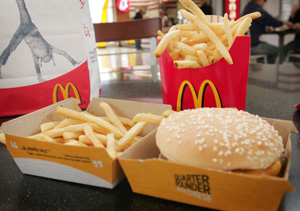
DES PLAINES, IL - FEBRUARY 15: French fries sit on a table at a McDonald's restaurant February 15, 2006 in Des Plaines, Illinois. McDonald's announced February 13 that their french fries contain potential allergens from both wheat and dairy ingredients used to add flavor. (Photo Illustration by Scott Olson/Getty Images)

Health insurance companies in the U.S., Canada and Europe hold nearly $1.9 billion in fast-food company stock, according to a new study from researchers at Harvard Medical School and the department of medicine at Cambridge Health Alliance. In the study, published this week in the American Journal of Public Health researchers examined major insurance companies’ stock holdings with five leading, publicly traded fast food chains: McDonald’s, Burger King, Jack in the Box, Yum! Brands (which owns KFC, Taco Bell, and others), and the Wendy’s/Arby’s Group. They found that, as of June 11, 2009, major health insurers owned $1.88 billion in fast-food stock, representing 2.2% of the companies’ total public holdings.

While some of the insurance companies have disputed the accuracy of these figures, the researchers found that U.S.-based insurance providers Prudential Financial, Massachusetts Mutual and Northwestern Mutual owned $355.5 million, $366 million and $422 million respectively in fast-food stock as of last June, with Northwestern Mutual representing the largest fast-food stock holding of any insurance company included in the study. ING, the insurance provider based in the Netherlands, held $406.1 million in these stocks. Canadian insurance provider Manulife held $146.1 million worth of fast-food stock. Those numbers, according to the study, were based on data from Yahoo! Finance from June 11 of last year.

The study authors argue that these findings show a disconcerting disregard among insurance companies for the a growing understanding of how the fast food industry is “increasingly understood to negatively impact public health.” Though they concede that fast food products can of course be consumed responsibly, the researchers emphasize that “the marketing and sale of products by fast food companies is done in a manner that undermines the public health,” and that having the very organizations that provide health insurance support these fast-food chains indicates corporate irresponsibility. As study author Dr. J. Wesley Boyd told the Wall Street Journal health blog:

“They’re profiting directly off the people who eat fast food, and if that leads to obesity or cardiovascular disease, they’ll charge you more for premiums if you have some of those conditions… They’re making money in either case.”

Health insurers should be “held to a higher standard” Boyd and colleagues argue before presenting two means of achieving that loftier standing. Insurance companies can either “divest themselves of holdings in fast food companies as well as other industries that have a clearly negative health impact,” they suggest, or they can use their ownership as leverage to force fast-food chains to adopt “practices consistent with widely accepted public healthy principles.”

The researchers concede that there are a few logical explanations for why health insurance providers might hold fast-food stock—to offset financial liability “associated with their policyholders consuming fast food,” due to a lack of understanding of the potential negative public health impact of excessive fast food consumption, or even simply due to a lack of communication between departments. Yet none of these explanations let the insurers of the hook, they argue. “If insurers are to play a greater part in the health care delivery system they ought to be held to a higher standard of corporate responsibility,” they write. “This responsibility includes aligning all o their resources—including financial investments—in ways that improve health or, at the very least, do not harm it.”

Related Topics: fast food, health insurance, stock, Public Health
  • Latest on Healthland

    Digital Vision / Getty Images

    CDC: Higher Income and Education Levels Linked To Better Health

    People with more education are more likely to earn a decent living and enjoy better health, according to the government’s annual health report.

    Learn Something New--Your Brain Will Thank YouCNN Health

    Getty Images

    Does A Better Memory Equal Greater PTSD Risk?

    Strong recall may be genetically associated with heightened flashbacks of trauma and pain, according to new research.

  • cssmcmap

    Yes, the problem of conflicts of interest in health care is a serious one, but this seems a little picayune. The demonizing of any company that sells any food other than organic wheatgrass or soy shakes and the idea that these insurance giants are engaged in some giant long-term conspiracy (“we’ll fatten them up and profit on their health bills!”) is silly.

  • braktalk88

    It’s the Circle of Life Siiiiiimba. Remememmmmber, rememmmmmberrrrrrr…

  • http://bachlva.wordpress.com bachlva

    “the idea that these insurance giants are engaged in some giant long-term conspiracy (“we’ll fatten them up and profit on their health bills!”) is silly.”

    That idea is not even remotely silly. If you don’t think the corporate heads are sitting around laughing about that you are so hugely mistaken.

    And FYI – everything else other than fast food is not “organic wheatgrass & soy shakes.” It’s time for you to get educated about what real food is as it’s clear you have zero concept of it.

    More importantly, I think you’re missing the point of the article. It’s clear you didn’t actually read it in full.

  • pies4ever

    The insurance industry have investments of hundreds billions of dollars. Since this article talks about US, Canadian, and European insurers it would be safe to assert that the insurance industries in these areas would have total investments in the trillions of dollars.

    I have read about this finding on other websites and they acknowledged that these figures “may” include holdings of index funds and mutual funds that might invest in this stocks. In other words some of these investments may not have been made deliberately by the insurers.

    So in addition to the fact that these investments are a very tiny fraction of the total holdings of these firms and that they may not have even purchased all of it deliberately, its a major stretch to jump from this finding to the argument that there is some major conspiracy that insurers are trying to ruin your health and thereby jacking up your premiums. Frankly, its a ludicrous argument.

    What is not mentioned in this article just how they determined “fast food”. What were all the restaurants and food companies that were included? Subway is a fast food joint but their food is often healthier than what many people eat at home.

    The point that insurers should be activist investors in the “fast food” companies that they do hold shares in also forgets just how large some of these fast food companies are. McDonalds is a $75 billion dollar company. Even if all of these insurers owned all of their holdings in the fast food industry only in McDonalds stock, that would only amount to 2.5% of the total common stock. Which is not nearly enough to assert firm control on the management decisions of McDonalds. But of course all these holdings are not held in only a single company.

    The combined fast food industry in all these countries is huge. The cumulative value of these investments are small. This whole controversy is contrived.

blog comments powered by Disqus