


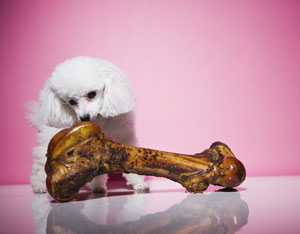
© Pulp Photography/Corbis
According to the Humane Society, nearly 40% of Americans own a dog, and roughly a quarter own more than one. Dogs provide us with companionship, protection, slobbery kisses, and recently, perhaps even clues for cancer treatments. So, it makes sense that owners want to give them some special rewards. Yet, though they may seem a natural treat, last week the U.S. Food and Drug Administration warned that animal bones—even large ones such as from a roast or large ham—can cause serious harm to dogs.
In an FDA press release veterinarian Carmela Stamper explained that: “Bones are unsafe no matter what their size. Giving your dog a bone may make your pet a candidate for a trip to your veterinarian’s office later, possible emergency surgery, or even death.” The FDA warning included a grim top 10 of why giving your dog a bone is a bad idea—among the reasons, the potential for severe bleeding, blocked intestines requiring emergency surgery and broken teeth. Stamper emphasized that it isn’t just what you give your dogs that you need to be careful about, but what they dig up on their own too. She advises carefully disposing of bones after meals, and suggests that owners “pay attention to where your dog’s nose is when you walk him around the neighborhood—steer him away from any objects lying in the grass.” Bone-like alternatives—made of hard nylon for example—are far safer than the real thing, Stamper says.
Here’s the full FDA list:
1. Broken teeth. This may call for expensive veterinary dentistry.
2. Mouth or tongue injuries. These can be very bloody and messy and may require a trip to see your veterinarian.
3. Bone gets looped around your dog’s lower jaw. This can be frightening or painful for your dog and potentially costly to you, as it usually means a trip to see your veterinarian.
4. Bone gets stuck in esophagus, the tube that food travels through to reach the stomach. Your dog may gag, trying to bring the bone back up, and will need to see your veterinarian.
5. Bone gets stuck in windpipe. This may happen if your dog accidentally inhales a small enough piece of bone. This is an emergency because your dog will have trouble breathing. Get your pet to your veterinarian immediately!
6. Bone gets stuck in stomach. It went down just fine, but the bone may be too big to pass out of the stomach and into the intestines. Depending on the bone’s size, your dog may need surgery or upper gastrointestinal endoscopy, a procedure in which your veterinarian uses a long tube with a built-in camera and grabbing tools to try to remove the stuck bone from the stomach.
7. Bone gets stuck in intestines and causes a blockage. It may be time for surgery.
8. Constipation due to bone fragments. Your dog may have a hard time passing the bone fragments because they’re very sharp and they scrape the inside of the large intestine or rectum as they move along. This causes severe pain and may require a visit to your veterinarian.
9. Severe bleeding from the rectum. This is very messy and can be dangerous. It’s time for a trip to see your veterinarian.
10. Peritonitis. This nasty, difficult-to-treat bacterial infection of the abdomen is caused when bone fragments poke holes in your dog’s stomach or intestines. Your dog needs an emergency visit to your veterinarian because peritonitis can kill your dog.
Download the FDA warning in PDF form here.