


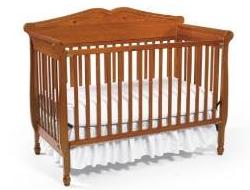
Rachel Convertible Dropside Crib by Graco Image: Consumer Product Safety Commission
The U.S. Consumer Product Safety Commission (CPSC) announced a recall of Graco brand wooden cribs manufactured by LaJobi Inc. All of the cribs affected by the recall have a drop side—or a side that can be lowered to facilitate reaching into the crib. So far 99 incidents in which the drop side either became unattached or the hardware broke have been reported to the CPSC and LaJobi. In a press release issued today, the agency states that:
The drop side hardware can break or fail, allowing the drop side to detach from the crib. When the drop side detaches, a hazardous gap is created between the drop side and the crib mattress in which infants and toddlers can become wedged or entrapped, posing a risk of suffocation and strangulation. In addition, children can fall from the cribs when the drop side detaches or fails to lock.
Two incidents in which children became trapped in the gap between the mattress and the drop side have been reported, and six cases have been reported in which children fell out of cribs due to failure of the drop side—including one case in which the child suffered a mild concussion. The wooden cribs have been on the market since 2007, and were sold in espresso, cherry, natural and white finishes for between $140-$200.
See the CPSC press release for a complete list of crib models affected by the recall.