


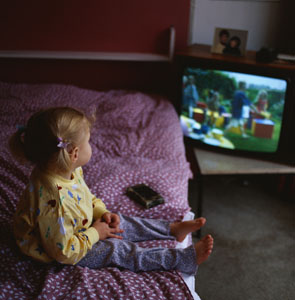
© Owen Franken/CORBIS
Studies have linked excessive TV-watching in young children to all manner of ills: an increased risk of childhood obesity and high blood pressure, problems with attention and language development, and a decrease in the quality of relationships between children and parents.
Now new research, published Monday in the Archives of Pediatrics & Adolescent Medicine, adds weight to the argument against watching too much TV, finding that kids who got more screen time at preschool age were more likely by age 10 to be disengaged at school, get picked on by classmates, be overweight and eat an unhealthy diet.
Conducted by researchers from the University of Montreal and the University of Michigan, the study analyzed data on 1,314 children who were involved in the Quebec Longitudinal Study of Child Development. Parents reported on children’s level of TV consumption at 29 and 53 months, while both parents and teachers evaluated the children’s academic, social and lifestyle habits at age 10. The children’s body mass index (BMI), a measure of obesity determined by a ratio of height and weight, was also noted.
The results, the study authors say, were striking. Based on their analysis, each additional hour of TV that children watched at 29 months corresponded with a 7% decrease in classroom engagement, a 6% drop in math achievement, a 13% decrease in physical activity on weekends, a 10% increase in video-game playing and a 10% greater likelihood of getting teased, assaulted or insulted by classmates. The authors say the findings underscore the importance of limiting TV-viewing during the toddler years, which are a critical time for development.
On average, the study found, children were watching nearly 9 hours of TV per week at 29 months, and nearly 15 hours per week by 53 months. (Children with more educated mothers watched less; those from single-parent homes watched more.) The American Academy of Pediatrics (AAP) recommends that children under 2 watch no TV at all; children older than 2 should get no more than 1 to 2 hours of “quality programming” each day. Although the TV-watching habits of children in the current study were within or close to the limits set by the AAP, the data suggest the children still suffered negative consequences.
When it comes to television, it seems less is better. Even “educational” videos, such as the Baby Einstein series, have been shown not to work. The AAP and pediatricians encourage parents to minimize the TV toll by keeping televisions sets out of kids’ bedrooms, monitoring what they watch and watching TV with their children and discussing the content — at the very least, TV can help spur intellectually stimulating and engaging conversation within families.