Cured, Smoked Meat Linked With Heart Disease Risk

© Catherine Karnow/Corbis
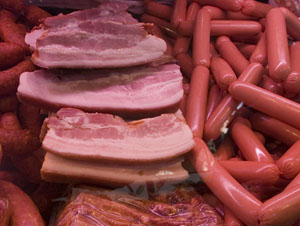
Budapest, Hungary --- Typical Hungarian sausages, hams, bacon, meats at Nagy Vasarcsarnok, the Central Market. --- Image by © Catherine Karnow/Corbis

Many studies have suggested that eating red meat can be harmful to your health — increasing the risk of death from cancer or heart disease — yet new research published this week in the journal Circulation suggests that the negative health effects may be limited to processed meats.

Researchers at the Harvard School of Public Health sifted through more than 1,600 studies, ultimately identifying 20 that investigated the link between meat consumption and disease risk in more than 1.2 million people. They found that, while eating processed meats such as cold cuts, sausage and bacon was associated with a 42% higher risk of heart disease, they didn’t identify any increased risk from eating unprocessed beef, pork or lamb.

Study authors say that this is the first major analysis of international data examining the impact of both processed and unprocessed meat consumption — and distinguishing between the impact of the two — on risk for both heart disease and diabetes. According to the analysis, individuals who regularly consumed processed meats had a 19% higher risk for developing type 2 diabetes on average, but again, researchers noted no elevated risk for the condition among those who ate unprocessed red meats.

The team of researchers, led by epidemiologist Renata Micha, defined processed meat as any lamb, beef or pork (but not chicken) that had been treated or preserved by smoking, salting or addition of other chemicals. They found that, people who consumed an average of 1.8 ounce (50 gram) serving of processed meat each day — the amount of meat in a hot dog or a couple slices of deli meat — faced 42% higher risk for developing heart disease and a 19% higher risk for type 2 diabetes.

The amount of saturated fat and cholesterol in processed meats is comparable to that in unprocessed meats, the researchers say, but the amount of preservatives — and sodium in particular — is significantly higher for processed meats. While previous studies have linked red meat consumption to increased risk for cardiovascular disease and certain types of cancer, authors of this new study point out that previous research has not distinguished between processed and unprocessed meats.

Based on these findings, the researchers argue that Americans should be encouraged to eat less processed meat — specifically trying to limit consumption to one serving or less per week.

These findings may add momentum to national salt reduction initiatives — including efforts by the U.S. Food and Drug Administration to devise a strategy for limiting salt content in food products. The findings may also prompt further research into the health effects of certain preservatives: this past January, an initial inquiry by the European Food Safety Authority suggested that chemicals used to “add smokey flavor” may pose health risks, for example.

Click to see how food labels can trick consumers.

Click to see surprising new contributors to obesity.

Related Topics: bacon, cold cuts, cured, deli meat, Diabetes, Heart Disease, preservatives, processed meat, red meat, salt, sausage, smoked, unprocessed meat, Heart Disease, Medicine
  • Latest on Healthland

    Photodisc / Getty Images

    Treating Cancer Is O.K. During Pregnancy

    Researchers have encouraging news for women who find themselves in a very frightening situation: having cancer while pregnant.

    Teen Pregnancy Rates Hit 40 Year LowCNN Health

    Nicholas Eveleigh / Getty Images

    Hold the Mystery Meat! Military Food Gets an Upgrade

    Military mess halls soon will be serving more fruits, vegetables and low-fat dishes under the first program in 20 years to improve nutrition standards across the armed services.

  • mkassowitz

    What is glaringly missing from this is data on the other content in most industrially produced meats today: hormones, pesticides and antibiotics. These are an increasing source of health problems in our society, yet seem to be generally overlooked. They are causing problems for our children: http://organicconnectmag.com/wp/2010/05/robyn-obrien-fighting-for-allergy-children/

  • http://japan-russia.jimdo.com/freedom/?title=forex parakori

    Red meat is not bad for you.
    Now blue-green meat, that’s bad for you!

    http://www.holylips.com

    ——————————

  • bob3905

    Speaking as one recently diagnosed with type 2 diabetes and who has eaten way too many hot dogs and sausages over my life I can attest to the information presented in this article.

    Upon closer examination it’s nearly impossible to avoid the bad food in our society today. All you can do in the end is chose the least dangerous. Start with removing the processed meats from your diet and don’t worry too much about the fruits and vegetables. Don’t toss your money away on organic products either. There is no real certification for that or free range raised livestock either.

  • Julie

    While I have not seen the study, there seems to be nothing here but correlation. Correlation is NOT the same as causation! This is my biggest gripe with almost EVERY popscience article on CNN, Times, etc. Huge, trusted news sources make this elementary mistake constantly. Is it really a mistake, or just a desire to have a sensationalist headline despite being misleading?

    To clarify: finding that two things correlate does not mean one causes the other or vice versa. For instance, ice cream consumption and murders both increase in summer. This does not mean ice cream consumption causes murder or vice versa.

    There MAY be causation involved, there may be a third variable causing both the conditions we see here (increased processed meat eating and increased risk of disease), or there may be any number of chain events in between. Ignoring this is irresponsible journalism and misleads the lay public who trust reporting.

  • desneduquesne

    It’s simple really. The smoke in smoke-curing is composed of creosote, given off whenever wood is burned. Creosote is a known carcinogen and is the bane of chimney sweeps. Don’t eat smoked meats, period.

  • http://tabulacrypticum.wordpress.com The Crypticum Keeper

    Julie, you have a point regarding correlation-vs-causation, but a 42% identified increased risk for processed meats vs no identified increased risk for unprocessed meats is significant and points toward causation. This isn’t irresponsible journalism at all. You’re overreacting.

  • jammies365

    Julie -

    It is unethical and economically difficult to do large scale human prospective studies on diet. You can’t very well ask a group of people to eat hot dogs and bacon for 30 years and ask another group to avoid them to get the data you want.

    Human research is a challenge. First, you find a correlation, then you tease apart potential causes, then you do animal studies. A correlation this strong is pretty impressive for this kind of work.

  • richdzien

    Well that’s simply not true about organic produce. Studies have shown that organic produce has more nutrients. Plus pesticides on fruit cause harm. For example, this study was just released recently.

    http://www.cnn.com/2010/HEALTH/05/17/pesticides.adhd/index.html

    GMO is not safe. GMO is only deemed safe because Monsanto is so powerful; they have ties to current members of the FDA, USDA, and even the Supreme Court.

    how anyone can think that chemicals and frankenfoods do not harm the body is beyond me. There’s a reason why there’s such an increase in physical and mental disorders in the past 30 years–that’s when food went bad!!

  • debbie338

    What they’re also leaving out is that even unprocessed red meat is linked with higher rates of colon and breast cancer.

  • bob3905

    Please let me clarify my comment on organic foods. I didn’t mean to dismiss them but to explain there’s no clear certification process that what you are buying and paying extra for is truly natural, organic product. We have a lot of tough choices to make today and it’s not clear at all what id the best route to take in buying the right foods. I am trying to buy the lesser evil but it’s hard to identify what is safe and healthier.

    When I was in a Safeway store the other day I saw two trays of bananas on opposite sides from each other. One was 79 cents a pound, the other, marked organic, $1.09 a pound. They appeared to be exactly the same. Could the store employees have mixed them up, maybe the customers? Are the organic truly what they are said to be and what should I look for that’s bad in the non-organic variety? Like I said, it ain’t easy.

  • bob3905

    So Mike Savage is right about something? I heard he’s totally against barbecue from a co-worker who told me he listened to Savage rant about it on his show. Here I was ready to dismiss it since this came from the man who denied autism really exists. Wow! I guess I should start listening to Michael Savage!

  • caddyrag

    Don’t think my home smoked meats fall into this category, cause it would be the death of me to give it up ..”defined processed meat as any lamb, beef or pork (but not chicken) that had been treated or preserved by smoking, salting or addition of other chemicals.”

  • naphtalicl

    If any of you are interested- there is a really great, very well researched, well written blog all about healthy eating. Turns out that most of what we are told in school is wrong. Fats are good- grains are bad- and chemicals are obviously no nos!

    http://starboard.flowtheory.net/blog/tag/aboutpaleo/

    Chemicals are a huge problem… but if we want to get to the root of why people think red meat is “bad” we should look at what we are feeding the animals! Grain fed animal fat will always be a problem… because grains are actually really bad for us. Grass fed meats are not only safe but GOOD for you.

  • austindeb

    Of course red meat causes cancer and heart disease. Duh! I gave it up three years ago when my mom told me on her death bed that she felt it caused her health problems. Guess who’s cholesterol and weight went down?

  • odinbob

    I generally agree with your complaint, except here they only used the word ‘associated,’ and only in the past-tense. I was rather impressed that they did not say ’cause.’ Even the authors in the journal article say:

    “All studies were observational, and residual confounding by imprecisely or unmeasured factors cannot be excluded. In particular, several studies did not adjust for other dietary habits or socioeconomic status. Thus, associations of processed meat consumption with diabetes mellitus or CHD could relate to generally less healthy diet or lifestyle rather than causal effects of processed meats.”

    As for Jammies – Julie’s argument wasn’t that the studies should be done; rather, it is just the limitations on conclusiveness of evidence. And ’42%’ does not reflect the strength of the correlation, but it is a striking positive magnitude. The 95% CI was 1.07 to 1.89 (that is, 7% to 89%).

  • odinbob

    That equals ‘post-hoc fallacy.’ It’s why we have science.

  • bkablik

    Like many other readers, I too cannot tolerate the irresponsible conclusions drawn in studies that are do not effectively eliminate huge variables. For starters, did this study try to control the key variable – BMI/weight? I’d love to see if there was a difference between obese people who eat processed meat vs. obese people who do not.

  • research1xx

    The crypticum

  • craiviolin

    That’s because of growth hormone in cows, and antibiotics in poultry and pork.
    The problem with the cured meats is
    due largely to nitres and phosphates.
    Hormel cold cuts are clean of all that poison. Monosodium Glutamate (MSG)
    which unfortunately is allowed to be legally hidden in many other preservatives (google MSG and find out) is also a major cause to many ailments.
    Organic, or free range meat is perfectly safe and does not increase changes of cancer.

  • mobadthangood

    Its not the meat thats hurting us its the stinking additives, preseveratives, hormone shots, and every other unnatural thing they put into chickens, cows and pigs.

  • ilinkthereforeiam

    Isn’t it pretty simple? Processed foods have lots of chemical preservatives designed to kill germs. Those same poisonous chemicals are not good for our cells, either.

    Jim Purdy
    The50BestHealthBlogs.blogspot.com

  • jim1969

    desneduquesne:
    Do you realize that there are 2 forms of creosote? Only the coal tar creosote has any health risks noted. Now I do not know about you, but I use wood to smoke things, not coal tar. If you, however, use coal tar to smoke your meats, please stop… Wood fire smoking has been around for thousands of years and if it was so unhealthy, I think the human race would have died off by now.

  • http://viniseera.wordpress.com viniseera

    I would recomment pure grape seed flour for heart diseases.
    http://www.winiseera.co.uk

blog comments powered by Disqus