


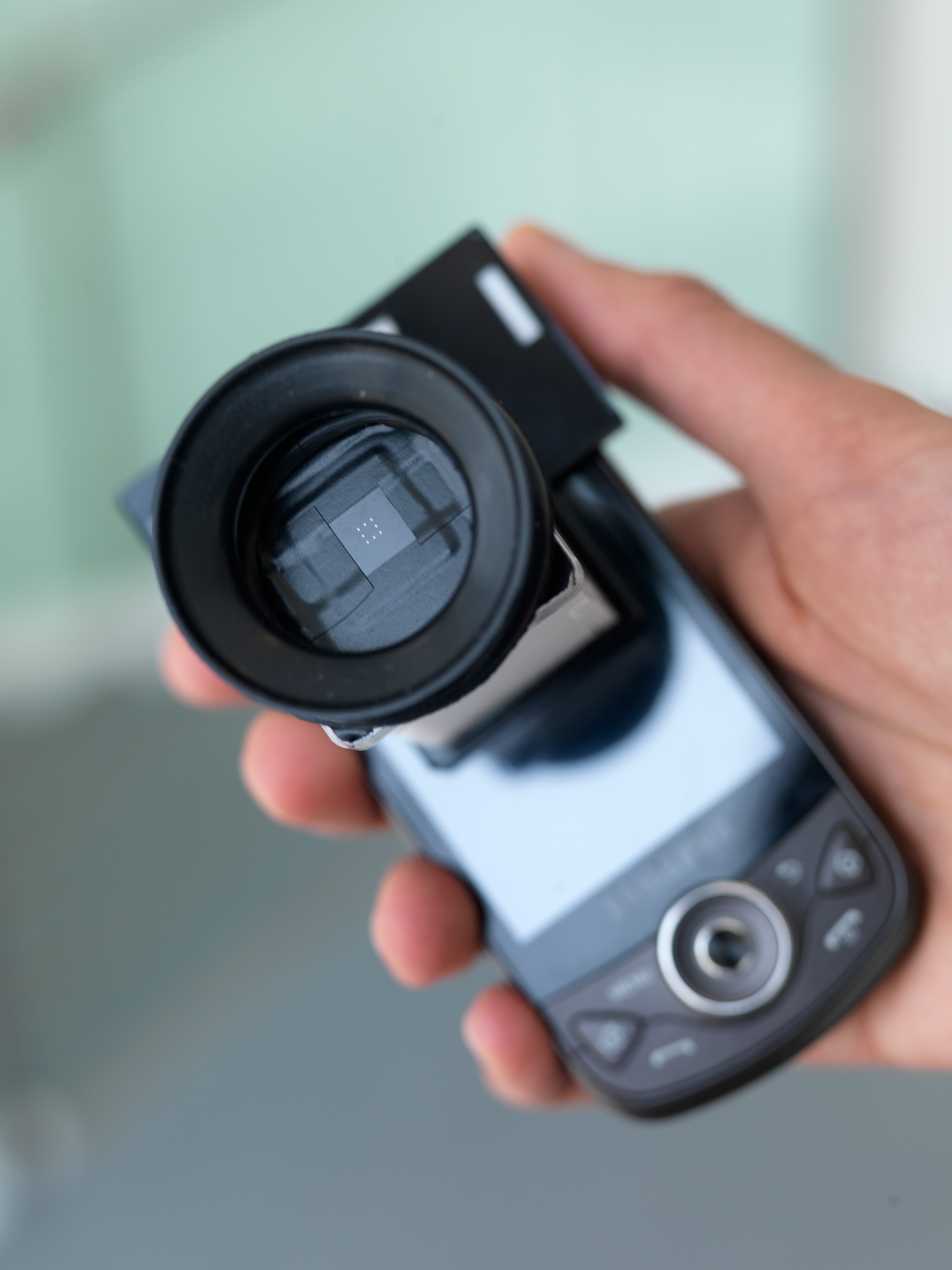
NETRA eye test device attached to a smart phone. Image courtesy MIT Media Lab
Researchers from the Massachusetts Institute of Technology’s Media Lab have come up with a way to test vision that doesn’t involve any hefty optometry equipment or even a visit to the eye doctor. A small, simple plastic device they’ve developed, when attached to the screen of a cell phone, can scan the eye and determine the appropriate prescription for a patient within minutes.
According to MIT News, here’s how the device works:
“The patient looks into a small lens, and presses the phone’s arrow keys until sets of parallel green and red lines just overlap. This is repeated eight times, with the lines at different angles, for each eye. The whole process takes less than two minutes, at which point software loaded onto the phone provides the prescription data.”
A paper detailing the functions, and applications, of the cell phone based eye test will be presented this July at a meeting of the Association for Computing Machinery’s Special Interest Group on Graphics and Interactive Techniques (or SIGGRAPH). The MIT researchers, Ramesh Raskar, Manuel Oliveira, Vitor Pamplona and Ankit Mohan, are hopeful that capitalizing on new technology can make eye exams more accessible for people around the globe. As cell phones are increasingly ubiquitous, most people would only need access to the inexpensive plastic device, which researchers say currently costs about $2 to manufacture now, but could get down to pennies each if produced on a larger scale.
The researchers plan to test the device in the Boston area this summer, and then go on to locations in the developing world for further testing. They have already applied for a patent on the device, which they’re calling the Near-Eye Tool for Refractive Assessment (NETRA), and under the company name PerfectSight they plan to manufacture it on a large scale — predominately for use in developing countries.