Pumping Iron? A Lighter Load May Give Better Results

I Love Images/Corbis

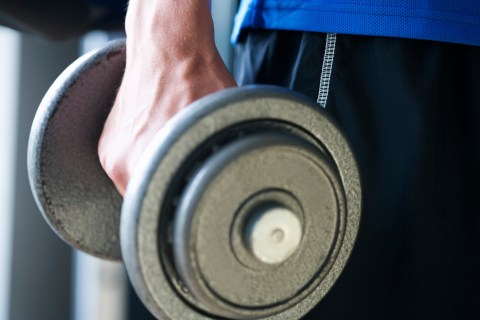
Enough with the grunting and groaning at the gym already. New research this week in PLoS One shows that, to build muscle, it’s more effective to lift a lighter weight many times than to lift a heavy load that you can only manage five or 10 times.

Researchers at McMaster University in Canada asked a group of young men to lift the heaviest weight that they could (doing just one lift) on a unilateral leg-extension machine. Some of those men were then assigned, in the weeks that followed, to exercise doing sets of leg extensions with a weight that was 90% of their max possible weight, while others were assigned to do sets with just 30% of their max weight. The catch: both groups were supposed to keep lifting until they could no longer get a full range of muscle motion when they attempted a lift — until their muscles, in other words, were too tired to continue.

Members of the lighter-load group were consistently able to perform greater total exercise  volume — that is, greater load X repetitions. More importantly, muscle biopsies and blood samples revealed that “low-load high volume resistance exercise is more effective in inducing acute muscle anabolism,” the researchers write.The low-load group had higher rates of myofibrillar protein synthesis at 24 hours after exercise.

This news may be helpful for recreational gym-goers who want to get more out of their weight routines. But the finding may have more important implications for patient rehabilitation, study co-author Stuart Phillips said in a statement. Elderly people, or people recuperating after an injury, may be intimidated when feeling weak by the thought of having to lift heavy weights. A lighter load can be perfectly effective for building muscle mass, the new research shows — provided you keep lifting long enough.

Related Topics: gym, lifting weights, weight training, Diet & Fitness, Exercise
  • Latest on Healthland

    Getty Images

    CDC: Doctors Are Increasingly Prescribing Exercise

    More and more U.S. adults are being told by their doctor to get out and exercise, according to government survey released Thursday.

    Teen Pregnancy Rates Hit 40 Year LowCNN Health

    Photodisc / Getty Images

    Treating Cancer Is O.K. During Pregnancy

    Researchers have encouraging news for women who find themselves in a very frightening situation: having cancer while pregnant.

  • Andrew Dudley

    Great article, with interesting results… thanks for posting!

    Andrew Dudley
    Sarcopenia.com

  • m2training

    Thanks Laura, however it’s not quite as clear-cut as you make out. The men in the group who performed leg extension until “volitional failure” at 30% of their 1RM, performed significantly more work per set in terms of repetitions (24, compared with 5 or 14); exercise volume (as load x repetitions) (1073 kg compared with 710 kg and 632 kg); and “time under tension” (43.3 seconds compared with 16.3 s and 27.1 s) of the 90%RM Fail and 30%RM work-matched groups.

    In fact they did about 96 reps in about 4.8 minutes of work compared to about 20 reps in 60 seconds of work in the 90FAIL group. Compared to the other groups they did about 4 times or 2.7 times more work.

    The authors write: “It is worth highlighting, however, the early amplitude of myofibrillar protein synthesis is dependent on contraction intensity as indicated by a greater response of muscle protein synthesis in the 90FAIL and 30WM conditions.” Intensity still matters.

    Their results show that (a) early protein synthesis is dependent on contraction intensity and (b) the duration of the response may be determined by exercise volume. They speculate that the “30%RM to “failure exercise mode, which increased proteins from all fractions in muscle including mitochondrial and myofibrillar proteins, may lead to both enhanced oxidative capacity and hypertrophy.

  • http://cfinn1973.wordpress.com/ Christian Finn

    Good point – the 30FAIL group did 50% more work than the 90FAIL group (1073kg vs 710kg), which goes a long way to explaining the increased protein synthesis in the 30FAIL group.

    The simple way to match training volume would have been for the 90FAIL group to do more sets (both the 30FAIL and 90FAIL group did 4 sets).

    Powerlifters and strength athletes using low reps (doubles or triples) will do more sets per exercise in order to get the volume in. As the number of repetitions goes up, the number of sets will go down. For example:

    3 sets of 8 reps = 24 reps
    4 sets of 6 reps = 24 reps
    5 sets of 5 reps = 25 reps
    6 sets of 4 reps = 24 reps
    8 sets of 3 reps = 24 reps

    So while the sets and reps change, the total number of repetitions stays pretty much the same.

    The way this affects training volume is shown near the bottom of this article:

    The Three Best Ways To Gain Muscle

    Suggesting, as the press release for this study does, that “building muscle doesn’t require lifting heavy weights” would be a valid conclusion to draw only if training volume was identical in both groups. Which it wasn’t.

  • yihaoj88

    http://www.watchesky.com cheap replica watches,welcome you arrive

  • midg3tman11

    Great article and I’ve actually got something to say about that. The ways that most programs show you how to workout aren’t actually helping you gain muscle at all. If you want to find out the truth about it and learn the proper way to gain muscle and see results within weeks just check out this article.

    http://hubpages.com/hub/The-easy-way-to-gain-muscle-mass?done

    Thanks

blog comments powered by Disqus