Itchy Bites: The Least of the Bed Bug Epidemic’s Threats

Oxford Scientific/Getty
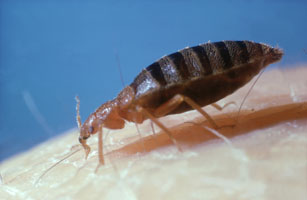
bed-bug: cimex lectularius on human

The bed bug — the reviled, bloodsucking ectoparasite (Cimex lectularius) that feeds silently on human beings during the night — has made a thunderous comeback in the U.S., everywhere from New York City to Cincinnati to Denver.

Bed bugs are so pervasive in New York City that they have shown up in Times Square movie theaters, a Hollister store in the upscale SoHo neighborhood and even the iconic Fifth Ave. New York Public Library, famous for its lion statues.

In fact, a city help line reported 34,000 bed bug–related phone calls last year. But the city that’s no longer sleeping isn’t alone: the Environmental Protection Agency and Centers for Disease Control and Prevention released a statement to address the national problem.

Now, with reports throughout the country of desperate bed bug sufferers dousing their homes in a variety of toxic agricultural pesticides — bed bugs having developed resistance to most insecticides that replaced DDT, which was banned in 1972 — the EPA has issued a more general warning about the health consequences of do-it-yourself pest control.

Recently, the Health Department in Ohio, the only state with three cities in Terminix’s recent ranking of most infested cities, petitioned the EPA to approve the use of propoxur, an outdoor insecticide, as an indoor bed bug treatment. But the compound is currently listed as a probable carcinogen and has been shown to cause birth defects and cognitive disabilities in rats, as well as nausea, dizziness and blurred vision in children. The EPA rejected Ohio’s bid.

That hasn’t stopped homeowners and unlicensed exterminators from running afoul of the EPA’s guidelines. The AP reports that exterminators have used toxicants meant for golf courses rather than cribs inside homes, sickening residents. Not only can these agents, often including a particularly harmful neurotoxicant called chlorpyrifos, cause certain types of cancer, but they are also associated with neurological and hormonal disorders in fetuses.

Many such pesticides are also highly flammable and authorities say improper use has caused a surge in house fires around the country.

As University of Illinois entomologist May Berenbaum argued in an op-ed earlier this month in the New York Times, bed bugs are relatively harmless, in that they do not spread viruses or pathogens as do other human-feasting insects: lice (Typhus), ticks (Lyme disease), fleas (Bubonic plague), mosquitoes (malaria, dengue fever, West Nile). So while bed bug bites might itch, frighten and occasionally become infected, some recently popularized cures may be worse than the disease.

Related Topics: bed bug solutions, bed bugs, exterminators, toxic pesticides, Environmental Health, Medicine
  • Latest on Healthland

    MECKY / Getty Images

    Skip the Strained Peas. Let Babies Feed Themselves

    Skip the spoon-fed puree and let babies go straight to finger foods, a new study suggests.

    Doctors Cheating in Dermatology ExamsCNN Health

    PETER DAZELEY / GETTY IMAGES

    Like Father Like Son? Y Chromosome Linked to Heart Disease

    Dad may be credited with more than just your facial features. A new study suggests that heart disease risk may be passed from father to son.

  • hdcase3rd

    The simple fact that bed bugs have (so far) not been shown to transmit diseases to humans is not the entire health issue. Bed bugs cause stress, anxiety, sleepless nights, shame, fear, and other negative mental states. All of these have an impact on health.

    The fact that individuals are resorting to desperate measures to exterminate these loathsome bugs points to the desperation of individuals who are enduring this plague. It’s time that health officials and the EPA stop dismissing bed bugs as a mere nuisance and take people’s suffering seriously. this is an epidemic that is going to cost us a lot in terms of time, money, peace of mind and our health. Emphasis should be placed on a long-term solution to the problem.
    http://www.pestcontrolcenter.com/blog

  • andydeluca

    The statement that Bed Bugs have developed resistance to most pest control products is not true. Bed Bugs have shown resistance to certain formulations of pyrethrum based pest control products but not all. There are many other EPA approved products that use active ingredients that are still highly effective against bed bugs including pyrethrum in its dust formulation.

    I believe that the problem is the miss information being disseminated on the internet and by the media and exterminating professionals that are not following guidelines published by experts which have been available for years.

    I have heard crazy things… people throwing out all of there furniture or fogging to kill bed bugs.

    We have developed and executed practical affordable solutions for residential, commercial, hospitals, governmental & educational facility.

    For more information see my blog at http://green-pestcontrol.blogspot.com/

  • http://kristinpgolden.wordpress.com kristinpgolden

    Safe and effective methods are certainly available. Chemical pesticides are just one method used to eradicate a bed bug infestation. Heat treatments prove to kill bed bugs in all stages of the life cycle — including the egg stage. And when implemented by a licensed, trained pest control professional, can elliminate these elusive critters with 6 hours. Conventional treatment must be applied every 10-14 days for a month-long period to be certain bed bugs that were in the egg stage of development are eliminated as well. Read more about it: http://www.jcehrlich.com/files/file_426527.pdf.

  • andydeluca

    Kristin is so right. we have been using steam and HEPA vacuums for over three years and have built a heat chamber. We also are one of the few pest conrol companies that perfome vault and tent fumigation in New York City area. http://www.bedbug-heatchamber.com/

  • souldawg

    May Berenbaum is actually right. Mold, ticks, toxic paint – all worse than bed bugs. Plus stinkbugs are harder to get rid of.
    http://www.houselogic.com/articles/what-could-be-worse-bedbugs/

  • hdcase3rd

    Whether one selects a chemical or heat treatment is very often a financial decision. Usually, the cost for heat treatment is significantly higher. However, heat is a one-time treatment and chemical treatments usually involve 3-4 sessions and the inconvenience that accompanies those sessions. Both types of treatments require extensive preparations on the part of the customer.

blog comments powered by Disqus