


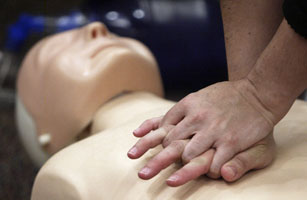
Three recent studies have found that when untrained bystanders perform mouth-to-mouth resuscitation as part of CPR on people who are in cardiac arrest, it does not improve patient survival rates.
In order to help the 92% of cardiac arrest patients who die before reaching the hospital, the American Heart Association (AHA) has traditionally recommended a CPR (for cardiopulmonary resuscitation) protocol that includes chest compressions and mouth-to-mouth “rescue breathing.”
But it turns out that idea of a lip-lock with a stranger makes people uneasy; plus most people don’t know how to do mouth-to-mouth correctly. The AHA estimates that only one-third of the 300,000 Americans who go into cardiac arrest in public each year are given CPR, and theorizes that part of the problem is the mouth-to-mouth obstacle.
In 2008, the AHA began exploring a new protocol in which civilian CPR training consisted of rapid chest compressions only. Now several studies have supported this change, finding that chest-compressions only CPR may not only be more palatable, but more effective at saving patients. The Wall Street Journal reports:
Growing evidence has suggested that skipping the mouth-to-mouth breathing in favor of rapid, chest-only compressions is as effective and easier for non-medical personnel to administer. The latest research, published in the Journal of American Medical Association, showed that chest-only compressions can be more effective than traditional CPR.
“Anybody can do hands-only CPR by pushing hard and pushing fast in the center of a person’s chest,” said Michael Sayre, an associate professor of emergency medicine at Ohio State University and the lead author of an AHA paper in 2008 supporting the use of “hands-only” CPR.
Further, a new study just released by the Arizona Department of Health Services reviewed survival rates and resuscitation care of 4,415 people who collapsed after cardiac arrest from 2005 to 2009. Of these patients, 666 received traditional CPR, including mouth-to-mouth, from a bystander; 849 received chest compressions only; and 2,900 got no aid.
The study measured survival by hospital discharge: 13% heart patients who received chest-only compressions were discharged from the hospital, compared with 7.8% of those who received conventional CPR. Of those who received no resuscitation whatsoever, only 5.2% left the hospital, showing that whether you do mouth-to-mouth or not, doing something is better than doing nothing.
In July, two studies published in the New England Journal of Medicine also supported the case against bystander mouth-to-mouth, even with a trained professional’s guidance. For one of the studies, telephone dispatchers in Seattle and Olympia, Washington, and London instructed bystanders in either chest-compression only CPR or chest compressions with mouth-to-mouth to help cardiac arrest patients: 12.5% of the hands-only group survived, compared with 11% of the traditional CPR group. A second Swedish study used the same methodology and found that in the hands-only group, 8.7% of patients survived for at least 30 days, compared with 7% in the traditional CPR group.
However, hands-only CPR applies only to adults. As the Washington Post noted:
Several experts said … that rescue breathing is essential for children in cardiac arrest, and for people who have suffocated or drowned. That’s because in them breathing stops before the heart, and restoring respiration might be enough to bring them back to life.
The AHA will again update its CPR guidelines on Oct. 18.