


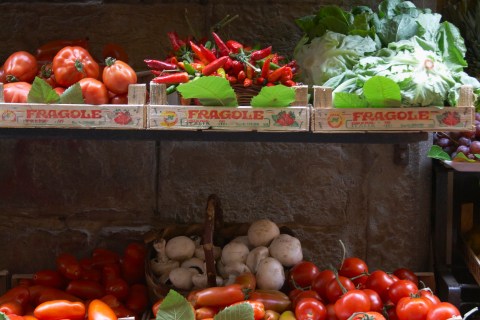
fruit and vegetables on an outdoor stall
To hear many people tell it, the cure for a lot of what ails both us and our planet is to eat locally grown food — and that makes sense. It’s in season, it usually comes from small farms instead of agribusiness operations and transporting food across the county leaves a much smaller carbon footprint than shipping it across the country. But local food costs more, which dissuades a lot of consumers on a budget. That’s the case at least when those consumers are shopping in the supermarket or at a produce stand. In a restaurant, there may be a whole different dynamic at work.
In a study conducted by Amit Sharma, assistant professor at Penn State’s School of Hospitality Management, customers at a student-run restaurant were offered the same dish made with either local or non-local ingredients, both priced at $5.50. After 322 diners had been served, there was no significant difference in which dish was chosen. When the investigators bumped the locally grown dish up $1 in price, to $6.50, however, sales followed suit, with 18% more diners choosing that option over the cheaper one. (More on Time.com: The ‘Other’ Salt: 5 Foods Rich in Potassium)
The reason, Sharma explains, is that the $1 premium is what’s known to marketers as a “value cue” — if it costs a little more, it must be worth a little more. Similar phenomena have been observed in other areas of commerce; when a newspaper is given away free in street boxes, for example, it may attract less interest than when the same product is sold for a quarter.
But a customer’s tolerance — and wallet — has limits. In Sharma’s study, when the price of the local dish went up one more dollar, to $7.50, sales dropped back down. “This is partly good news for restaurants,” Sharma says. “It shows that customers were willing to pay slightly more for a local dish, with the emphasis on ‘slightly.'” (More on Time.com: Photos: From Farm to Fork)
Interestingly, no matter what the price, customers in the study did not indicate that they ever came to a restaurant specifically for local fare. That simply is not a major selling point — at least not yet — when people are picking where to eat. Once they’ve sat down, however, the menu can persuade them. Local food, sold right, can apparently be good for what ails the cash register too.
More on Time.com: