



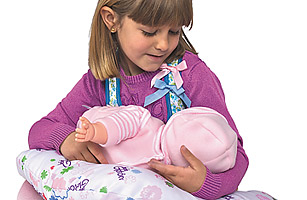
Little girls love mimicking their mommies. They clomp around in high heels, push toy Dyson vacuums and tenderly strap stuffed animals into baby strollers. Big sisters — and brothers — who see their mothers nursing a new baby sibling often pretend to do the same. Lifting their tiny tees, they smush a doll or, in my daughter’s case, a panda to their chest. As parents, we race for the camera and post the adorable pics on Facebook. So why all the brouhaha over the The Breast Milk Baby?
“Yuck” is the general reaction that the sweet-faced Spanish import is receiving in the U.S. It’s apparently a hit in Europe, but more prudish Americans are clamoring to decry the inappropriateness of a doll that lets a young girl pretend to breast-feed. The six models — Cameron, Jeremiah, Lilyang, Jessica, Savannah and Tony — are sold with a flowered halter top for your breast-feeder-in-training to wear. Hold the baby to the strategically placed flower “nipple,” and the doll moves its mouth and makes associated suckling sounds.
Granted, it’s — pardon the pun — pretty over the top. But it’s hardly odder than the anatomically correct boy-doll my mother-in-law bought my son; fill it with water and it obediently wet the plastic potty it came with. Yet while urinating — and defecating — dolls are commonplace, major retailers have shied away from Breast Milk Baby so far, although manufacturer Berjuan Toys intends to tout the doll’s appeal at a mega-trade show later this month in Las Vegas. All said, there’s been a lot of fuss over a doll that’s only available for the time being through the company’s website and from an enterprising eBayer in Puerto Rico.
LIST: Top 10 Breast-Feeding Controversies
Berjuan, meanwhile, is milking its 15 minutes of fame for all it’s worth. On its website, the company trumpets that “God Supports The Breast Milk Baby” and U.S. spokesman Dennis Lewis complains of being labeled “perverts and pedophiles” for promoting breast-feeding. “Churches all over the world are filled with images of Mary nursing baby Jesus, and yet we can’t imagine letting our daughters learn how important breastfeeding is for our society?” he says on the site.
Religious guilt aside, it’s undeniable that the doll is a good match for children, who are naturally curious about biology. The Breast Milk Baby simulates the miraculously complex way a woman’s body can produce all the food her baby needs for many months. It’s one thing to castigate Bratz dolls with their sultry, made-up eyes and Angelina Jolie lips or Barbies with their infinitesimal waists and big boobs; they ooze sexuality and project unattainable body ideals. If anything, The Breast Milk Baby is a refreshing change from the doll-as-tarted-up-playmate paradigm: it’s not about sex; it’s about eating.
“People are confusing breast-feeding with sex,” says Melissa Bartick, an instructor of medicine at Harvard Medical School and a member of the Board of Directors of the U.S. Breastfeeding Committee. “In our culture, breasts are considered a sexual part of the body rather than a nurturing part of the body.”
MORE: Study: Breast-Feeding Moms Get Just as Much (or Little) Rest as Formula-Feeders
But even dolls — like people — have to eat. Breast Milk Baby is stirring up controversy, but it could be argued that those tiny toy bottles — the kind with white or orange liquid that magically disappears when tilted upward — that often accompany a store-bought doll are simply promoting formula and bottle-feeding. At a time when the U.S. is trying desperately to boost breast-feeding rates, maybe it’s the bottle-slugging baby dolls that are the more dastardly toy.
As Bartick wrote in a Huffington Post commentary:
The toy bottles do not send a neutral message, after all. They send the wrong message — that bottle feeding is normal and desired, at a time public health advocates and major medical organizations and our own Surgeon General are trying to convey the message that breastfeeding is the normal way to feed a baby, and that not doing so incurs multiple increased health risks to children and their mothers alike. We face an epidemic of childhood obesity, so why is it OK for young girls to feed their dolls a food that is linked with higher rates of all kinds of health problems?
I loved breast-feeding and felt an unbearable sadness when I weaned my youngest last year. To me, breast-feeding was about far more than physical nourishment; it was about emotional nourishment — for both my babies and me. But I can say with near certainty that I wouldn’t have forked over a C-note to enable my kids to hear swallows and gurgles and pretend to breast-feed. Kids are masters of make-believe: in my house, a long scarf looped around small shoulders easily becomes a Baby Bjorn for a Groovy Girl. And a panda still works just fine as a nursling.