


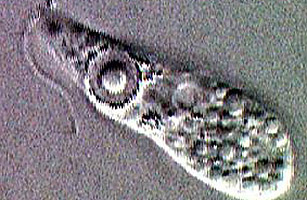
Naegleria fowleri
Three people have died this summer from a rare infection with a waterborne amoeba that attacks the brain.
The most recent deaths, which occurred this month, involved a 16-year-old in Brevard County, Florida, who may have become infected while swimming in a nearby river, and a 9-year-old in Henrico County, Virginia, whose mother said he attended a fishing day camp the week before he died.
The culprit is an amoeba called Naegleria fowleri, which flourishes in warm waters, particularly in summer in the southern U.S. It causes rare infections in humans, but when it does, it is 95% deadly, CNN’s Madison Park reports.
Early symptoms of infection include headache, fever, nausea, vomiting and neck stiffness. Later symptoms progress to confusion, balance problems and seizures. Often, when cases are presented at the hospital, they’re mistaken for bacterial meningitis. Death usually occurs within a week of symptom onset.
Like something out of a horror movie, the amoeba enters the human body through the nose, usually after a person has swum or dived into a warm body of fresh water, such as a pond, lake, river or hot spring.
Park reports:
The amoeba is not a parasite. A human is an “accidental end point for the amoeba after it’s forced up the nose,” Yoder said. [Jonathan Yoder is the waterborne disease and outbreak surveillance coordinator at the Centers for Disease Control and Prevention]. It does not seek human hosts.
But when an amoeba gets lodged into a person’s nose, it starts looking for food. It ends up in the brain and starts eating neurons.
But before you panic, remember that infections with the amoeba, while tragic, are extremely uncommon. There are usually only two or three cases a year in the U.S.
Read CNN’s full coverage here. For more on Naegleria fowleri, including tips for preventing infection, check out the CDC’s comprehensive FAQ here.