


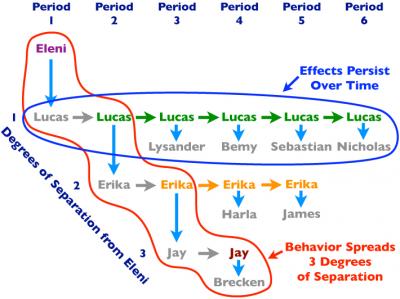
Diagram illustrates how generosity persists through three degrees of separation.
One person’s initial generosity can spark a chain reaction of benevolence, according to the latest study from prolific social contagion researchers James Fowler and Nicholas Christakis.
The findings, published early online in the March 8 issue of the Proceedings of the National Academy of Sciences, add to the duo’s previous research into the social contagion effect on everything from obesity and loneliness to happiness, optimism and quitting smoking.
In this latest research, James Fowler, an associate professor of political science at the University of California, San Diego, again teamed up with Dr. Nicholas Christakis, a medical sociology professor at Harvard Medical School, to see if it truly does work to “pay it forward.”
To test their theory about the potential spread of cooperation and generosity, Fowler and Christakis recruited volunteers who didn’t know one another, and ensured that every individual interacted with each other participant only once, to rule out the possibility that generosity might be the result of increasing familiarity.
Subjects participated in games in which they had the opportunity to foster cooperation by contributing money to others (in what the researchers referred to as a “public-goodx game”). They found that, compared with those who hadn’t benefited from others’ generosity, study participants who received money in an earlier game were more likely to give money in a later game. Ultimately, the initial person’s contribution was multiplied up to three times — a result in keeping with earlier findings on social contagion, suggesting that this sort of ripple effect continues for three degrees of separation.
Though it may be encouraging to learn that altruism can be passed on through social networks — particularly in light of recent tragedies in Haiti and Chile that left so many people in need of help and kindness — the study also found that selfish, uncooperative behavior tended to spread through groups. That contagion effect was no more pronounced than that of generosity, however.
And while both cooperation — and the lack of it — may spread through social groups, it’s more likely that benevolent ripple effect had significant evolutionary benefits. Actions that increased cooperation likely increased a group’s ability to survive, the authors suggest. And because generosity can be contagious, one initial altruist may have been all it took to spark cooperation throughout a whole village.
Fowler and Christakis wrote about the influence of the contagion effect through social networks in the 2009 book Connected.