


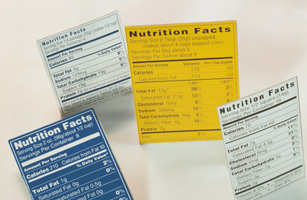
When the Centers for Disease Control and Prevention (CDC) teamed up with the Institute of Medicine (IOM) to issue a report on October 13 calling for clearer nutritional information on food packages, their focus was largely on “front of package” (FOP) labeling — which is essentially just marketing in the form of nutritional labeling. I know I’ve fallen prey to it, selecting the can of soup that claims it’s “Now with less fat!” without first looking at the back nutrition panel. If I had, I would have seen that the soup-maker had replaced the fat with a whole bunch of salt.
From the manufacturer’s perspective, it makes sense: if you remove one flavorful element of a food, you have to replace it with another. Usually, that means fat-free foods are loaded with added sugar or salt. But that information doesn’t make it into a banner FOP label. (More on Time.com: The ‘Other’ Salt: 5 Foods Rich in Potassium)
Given the discrepancies between what the FOP label promises and what the Nutrition Facts panel on the side or back of the package reveals, the IOM report calls for an end to misleading or whitewashed nutritional advertising. It states:
As FOP labeling has multiplied, it has become easy for consumers to be confused about critical nutrition information. Adding to the confusion, manufacturers use a variety of FOP nutrition rating systems, with different and often conflicting criteria that can yield varying results.
For instance, one package of cookies displays calories per serving on the FOP label, while another displays calories per 100 grams. What looks like an easy calorie-to-calorie comparison really isn’t — you’d need a calculator to figure it out. More confusingly, one company may tout calorie content on the FOP label, while another chooses to advertise a similar product’s “Whole Grains” content, making it virtually impossible to compare or evaluate the relative merits of each. (More on Time.com: Figuring Out Food Labels)
To combat the problem, the IOM recommends a standardized rating system that displays the total calories in the package along with serving size information, using a more consumer-friendly unit of measurement: cups or tablespoons, for instance, instead of grams or ounces.
While it may be impossible to label all packaged food under one system, the IOM committee believes that clearer, more streamlined information will undoubtedly help consumers make healthier choices at the supermarket.
More on Time.com:
How to Evaluate Nutrition: Building a Better Label
Reshaping the Pyramid: Federal Dietary Guidelines to Change