

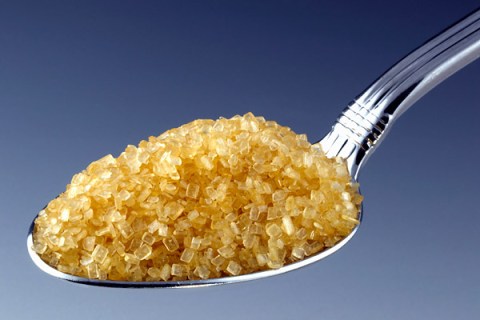
Popularized by the ubiquitous Sugar in the Raw brand found in every Starbucks shop and many supermarkets, the coarsely grained, light-brown turbinado sugar gets its name from the turbines that are used to process it. The “raw” name is somewhat misleading, however, since Sugar in the Raw isn’t actually raw, as in totally unrefined. Turbinado sugar is what’s left over after raw sugar cane juice has been stripped of its natural molasses and impurities, as well as its vitamins, minerals and other trace elements.
For a less-processed alternative with small amounts of nutrients in it as well, look for sucanat, which is simply dehydrated sugar cane juice. Sucanat (an abbreviation for sugar-cane-natural) has a stronger molasses flavor than refined white sugar and retains all of the nutrients found in natural sugar cane juice, including iron, calcium, vitamin B6 and potassium. Though, as New York University nutritional scientist Marion Nestle points out: “The amounts of trace minerals in raw sugar are so small that they are nutritionally insignificant.”
Nonetheless, those extras, along with the additional water content, help reduce the sucrose — the main component in sugar that makes it sweet — in sucanat to about 88%, versus 99% for turbinado and 99.9% for refined, white sugar. All three still have 15 calories per teaspoon, however.
(MORE: Should Sugar Be Regulated Like Alcohol and Tobacco?)
Both turbinado sugar and sucanat can be used as direct substitutes for brown or white sugar in baking, and their molasses-like flavors work especially well in brownies, barbecues sauces and in your morning cup of Joe. Just remember to use either in moderation: you’re likely getting a tremendous amount of added sugar — sugar that’s added during processing to foods that wouldn’t normally have it — in your diet already. There’s no sense in piling on much more. The American Heart Association recommends that most women consume no more than 6 teaspoons of added sugar per day, while men should limit their intake to 9 teaspoons per day. “When it comes to sugars, less is better,” says Nestle, whose new book, Why Calories Count, is due out in April.
But if you need more sweetness to make it through your day — I know I do — it’s best to counter the extra calories with a brisk walk or other exercise.